$350,000 awarded at the
2009 Astronaut Glove Challenge
Held at the
historic
Astronaut Hall of Fame
in Titusville,
Florida
November 18-19, 2009
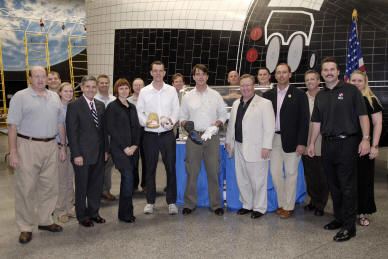
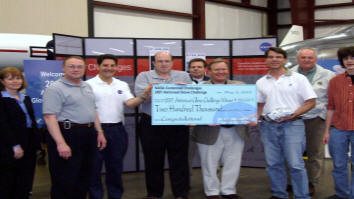
Peter Homer (Right Center) won 1st prize of $250,000,
and
Ted Southern (Left Center) won 2nd prize of $100,000
Kennedy Space Center (November 19,
2009) – Peter Homer of Southwest Harbor, Maine won
$250,000 and Ted Southern of Brooklyn, NY won
$100,000 at the 2009 Astronaut Glove Challenge. The
competition was held at the historic Astronaut Hall of
Fame in Titusville, Florida near NASA’s Kennedy Space
Center. It
was managed for NASA by Volanz Aerospace Inc., a
non-profit space education organization based in Owings, Maryland.
Secor Strategies LLC of Titusville was the commercial
sponsor for the event.
The Astronaut Glove Challenge seeks
innovative glove design concepts to reduce the effort
needed to perform tasks during spacewalks.
In this
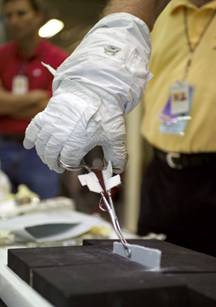
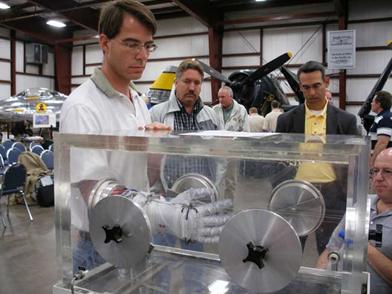
challenge, competitors demonstrated their glove design
by performing a range of tasks with the glove in an
evacuated chamber. The gloves were also tested to ensure
that they would not leak. In order to qualify for a
prize, the gloves had to meet all of the basic
requirements and also exceed the flexibility of the
current NASA spacesuit glove.
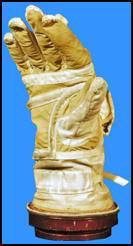
For the 2009 Challenge, teams had to provide a
complete glove, including the outer,
thermal-micrometeoroid-protection layer and the inner,
pressure-restraining layer.
In the 2007 competition, only the
pressure-restraining layer was required.
The two competitors were tied in
several categories but Peter Homer, who won $200,000 in
the first Astronaut Glove Challenge in 2007, claimed
first prize this time by outscoring his rival in
joint-flexibility and in the pressure test.
Ted Southern, who captured second place, also
competed in 2007 but was not successful in his first
attempt.
According to Alan Hayes, Chairman and CEO of of
Volanz Aerospace Inc., “Both competitors improved
their designs significantly from 2007, but Ted’s
progress was especially impressive.”
The designs presented in the
competition were measured and evaluated by engineers
from NASA’s Kennedy Space Center and Johnson Space
Center and NASA’s spacesuit-manufacturer, ILC Dover.
“It is remarkable that two designers working on
their own could create gloves that meet the requirements
for spaceflight – a task that normally requires a large
team of experts”, said engineer Kate Mitchell of the
Johnson Space Center.
The Astronaut Glove Challenge is one
of six Centennial Challenges managed by NASA's
Innovative Partnership Program, which provides the prize
funds. This was the fourth consecutive Centennial
Challenge event with prize winners and the program has
awarded 3.65 million dollars this year.
“Our challenges have been difficult, multi-year
efforts and in many cases it has taken several years for
competitors to perfect their designs.
We are now seeing the results of their
perseverance.” according to Andrew Petro, Centennial
Challenges Program Manager.
The next Astronaut Glove
Competition will be announced in early 2010
Download the latest edition of the
2009
RULES
(5.1)
Download the latest edition of the
2009
Team
Agreement
(5.2)
Glove
Capabilities/Contest Goals
-
-
¨Improved
manual dexterity and flexibility
-
¨Lighter
weight, stronger, more durable
Questions, Questions, and more Questions...
Got a question about the
competition? Send all inquiries to:
ahayes at juno.com
(take out spaces, and replace at
with a @)
Please Note: This is a new
(and temporary) email address!